Camino Map

Tuesday, 12 July 2016

Stage 24: Foncebadon to Ponferrada (28 km--9-26 degrees)


A howling wind greeted us when we woke at 5:00 in the tiny village (ghost town) of Foncebadon.  It reminded us that the forecast low was 8 degrees.  We all dressed for maximum coverage, Laurel even had socks on her hands at one point.  Our path followed a foggy, cold, wind-swept ridge past the Cruz de Ferro (Iron Cross), the spot where we deposited our stones the day before.  Cows and other hikers appeared and faded away in the mist as we plodded along to the end of the ridge and we begun a decent that would last most of the day.  Down, down, down we went, our minds began to wander as well. "When will it stop, I don't remember climbing that high?", "We missed second breakfast, I'm hungry!", "Where's the Tiger Balm, my legs hurt?"  

After three hours the fog lifted and we saw how beautiful the scenery actually was.  We descended through mountain villages that were just waking up, but had no coffee or bathrooms to offer.  The village of Molinaseca welcomed us at 10:30 and we stayed for a picnic lunch beside the river. The remainder of the walk to Ponferrada was flat and beside a busy highway.  The temperature had risen to 26 degrees by the time we checked into our hotel.

After showers, we headed out for supper at 16:00 and to explore the Templar castle in the centre of town.  We were back in our room and complaining about the heat by 7:00 pm--too cold and too hot in the same day!

Trusting Neighbours


The Maragato people that founded the village of Castrillo de Los Povazares (see Stage 22) were so honest that, in the past, when they went away, they would leave the key in the door so if their neighbours needed anything they could go in and help themselves.  Today we can still see the large and ornate door locks but without the keys.  Either the Maragato no longer trust their neighbours or all the keys have been stolen!

Monday, 11 July 2016

Stage 23: Castrillo de Los Polvazares to Foncebadon (24 kms--17 degrees)


Today, we had big changes in the weather and the scenery -- both shifts were quite welcome!  The temperature cooled down, which along with a breeze, made our hiking much more comfortable than the sweltering heat of the past few days.  The trail was more shady and took us higher up, though at a gentle rate that was not tiring.  Since sun-up, ahead of us, we could see the mountains of Galicia, and reached them by the time we stopped for the day at 11:30 am.   Along the way, we passed through pretty villages of stone houses, roses, bustling albergues, and coffee stops.  It was a thrill to share the trail for the first time with peregrinos travelling on horseback; when we arrived in Foncebadon (our stop for the night), there they were again, the horses feeding on grass while the pilgrims grabbed a coffee!  Other animals we saw today were cats, dogs, rabbits, cows, a donkey, a fox, and a woodpecker.  Foncebadon was practically a ghost town, down to a population of just two people in the 1990s, but has been revived by the opening of four albergues in recent years, thanks to the increasing popularity of the Camino.

Two kms past Foncebadon, is the highest elevation on the entire Camino.  An iron cross atop a high pole marks the spot.  Over the years, peregrinos have placed stones there from around the world, accompanied by prayers and messages of hope, so that now there is a large pile of stones at the base.  We walked there in the afternoon, and added our stones and wishes, too.  Early tomorrow morning, we will pass there again, but it most likely will still be quite dark.

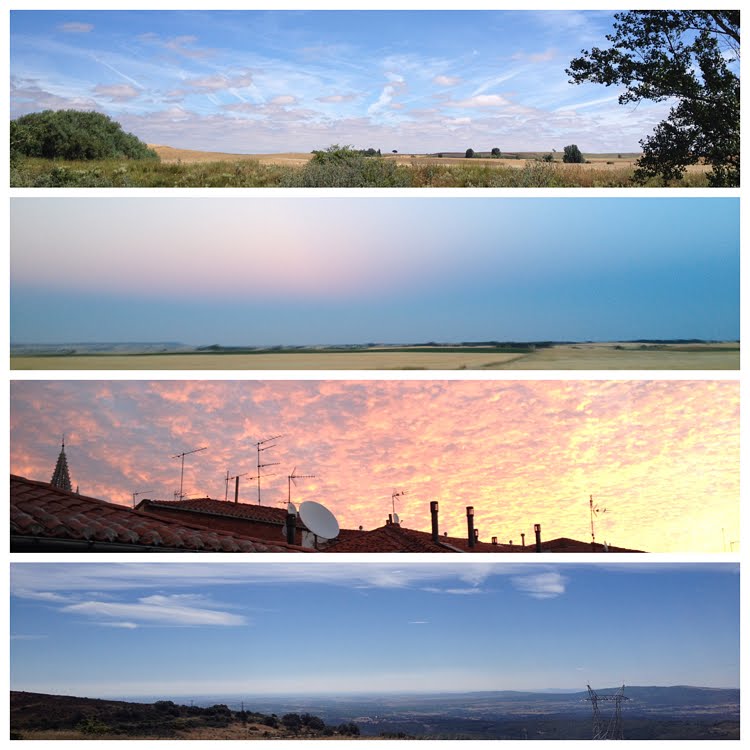
Skies of the Meseta


Yesterday, we finally reached the end of the long, flat, hot Meseta and transitioned to our next section, which is through the cooler Cantabrian Mountains into Galicia.  Our stopping point for tonight (July11) is the village of Foncebadon; it is positioned high up where we can look back to see the Meseta stretching out behind us as far as we can see . . . seeing that, we can hardly believe that we walked the length of it!  The top photos show some skies of the Meseta from various points along the way; the last photo is the view over the Meseta from Foncebadon.

Sunday, 10 July 2016

Historic Muleteer Village

Castrillo de los Polvazares is a village situated in Leon, in North-west of Spain. It's important due to its history, as one of the few places of the "Maragatería" which still keeps its traditions and was one of the main resistances against the French conquests.

Stage 22: Hospital de Orbigo to Castrilla de los Polvazares (25 km - 30 degrees)


We left Hospital de Orbigo before the sun came up and walked towards the mountains. Even though I loved the Meseto I will be happy for the cooler temperatures that I hope the mountains offer!


There were so many beautiful and interesting sights along the way today that it is impossible to fit them all into the traditional 3 grids. I have decided to give our end destination it's own. Below shows some of what we observed along the way to Castrillo de los Polvazares.  Both the first two pilgrims (Laurel and the bronze pilgrim) are taken on the approach to villages we passed through. Laurel's lavender is on the outskirts of Murias de Rechivaldo and the bronze pilgrim is in Astroga's mayor square. The next photo is of the Ayuntamiento in the same square and has two Maragatos who mark each hour by striking a bell in the tower.
The photo of the castle was built and designed by Gaudi for the local Bishop in 1915. It is called the Episcopal Palace and is located just across the road from the cathedral, pictured next.
The last two photos are of today's flowers observed along the way. The Spanish really love their flowers and we are always reminded to 'stop and smell the roses' as their fragrance is a constant reminder.


These were some of the highlights of the day for me. We always eat our first breakfast in our room but at about 10 km today we unexpectedly came upon a food stand where we ate a second breakfast. These kind individuals have set up this stand free of charge for all pilgrims! Third breakfast occurred in Astorga where we had a traditional English breakfast in a very beautiful square. I could not forget to include a much needed Aqua con gas (sparkling water), the road sign indicating that we had arrived at our destination and Jacko tran who transports Laurel and my bag to our hostel daily! I have included a third grid to show you some of the incredible sights of today's walk, but I wanted you to be aware that on Hot walks it is sometimes the breaks that make the list of my day's highlights.

Saturday, 9 July 2016

Stage 21: León to Hospital de Orbigo (28 km--34 degrees)


Today we got up early, caught a cab at Plaza Mayor, just below our home for the past three days, and said goodbye to the Cathedral and the buried Kings of Leon.  The taxi spared us the the experience of Leon's industrial park and gave us an hour head start on our walk.

For over a week we have been walking through the meseta, but it could easily have been Saskatchewan.  Outlook, Glenside, Wilkie, Lumsden, Stewart Valley, Moose Jaw, and their environs would not have looked out of place along our path.  Most perigrinos barely tolerate the meseta and rejoice at the site of the Cantabrian Mountains. As avowed "flat landers"  we respect elevation and some of us even fear it.  As the mountains came into our view today and grew larger as we walked towards them we saw the magnitude of the challenge that lay ahead.

For most of the trek we have escaped the extreme heat of the meseta, but today felt 34 degrees on a mostly shadeless road. We tolerated it but not without many stops for water and rest.  Today's highlights included seeing storks up close, being buzzed by several powered  paragliders, wall art, and a 200 metre 13th century bridge that led to our Albergue.  We ate supper at 2:30 and were confused with what we got, I ordered a "number 8," which turned out to be deep fried cheese and bologna with squid, indisputable proof that Newfoundlanders settled Spain or that I gotta learn more Spanish!